Why do we worry so much?
Why do we procrastinate?
Why do we overthink things?
Why do we cling to unhealthy relationships?
Why do we keep making the same mistakes?
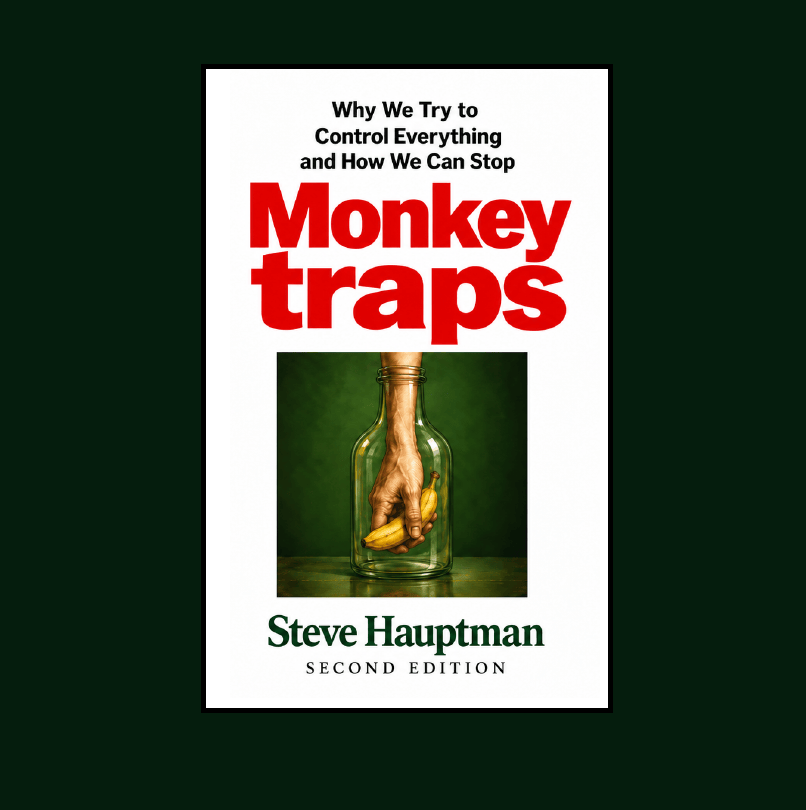
Monkeytraps explores a surprising possibility: that many of our most common emotional problems come from the same underlying habit—trying to control what we cannot control.
This revised second edition offers a different way to understand why we struggle, and practical suggestions about how we can live with less stress and more peace of mind.
***
“I have read and reread this book. It’s on a constant loop. I keep it in my handbag and read a chapter whenever I need reassurance, connection, guidance and inspiration. Chapters are short and sweet, so easy to digest. It’s laid out so you can flick quickly to a topic, and I dip into it almost daily.”
~ Alison Lowrie, BACP Registered Counselor
COMING SOON
The Second Edition will be available shortly.
Notify Me When It’s Published
Meanwhile, read the Introduction and the first three chapters
We all try to control our lives. Much of our controlling is necessary and useful. But sometimes it causes more problems than it solves. Monkeytraps explores how that happens—and what we can do about it.
Monkeytraps explores how that happens—and what we can do about it.
Here’s how the book begins.
Introduction
Want to trap a monkey?
Try this:
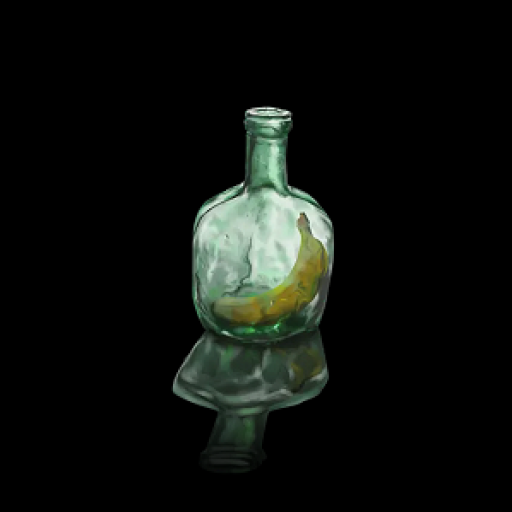
(1) Find a heavy bottle with a narrow neck.
(2) Drop a banana into it.
(3) Leave the bottle where a monkey can find it.
(4) Wait.
The monkey will do the rest.
He’ll come along, smell the banana, reach in to grab it.
Then find he can’t pull it out, because the bottleneck is too small.
He can free himself easily. He just has to let go.
But he really, really wants that banana.
So he hangs on.
He’s still hanging on when you come to collect him.
And that’s how you trap a monkey.
***
Want to trap a human?
Try this:
(1) Place the human in an uncomfortable situation.
(2) Wait.
The human will do the rest.
He or she will try to reduce their discomfort by controlling the situation.
The harder they work to reduce their discomfort, the more uncomfortable they’ll get.
The harder they try to escape their discomfort, the more trapped they’ll feel.
And that’s how you trap a human.
***
This is a book about control in general, and psychological monkeytraps in particular.
About control:
I think of it as a myth.
By myth I don’t mean a false belief or a fairy tale, but a story we tell ourselves about reality and our place in it.
I see the myth of control as essential to human functioning.
It is the life preserver to which we cling in the face of life’s unpredictability, cruelty and chaos.
It is the hope that, faced with pain or confusion or helplessness, we can stay afloat through all that.
I see our belief in control as our chief defense against a reality largely beyond our control.
I remember reading this somewhere:
Because man is not God, he had to create one.
That’s how I see this myth.
It is because we lack control that we need to believe in its possibility.
***
About monkeytraps:
A psychological monkeytrap is any situation that tempts us to hold on when we should let go — to control what either can’t or shouldn’t be controlled.
The world is filled with monkeytraps.
As is the emotional life of every human being.
I learned this from practicing psychotherapy.
Therapy also taught me four truths:
- We are all addicted to control.
- This addiction causes most (maybe all) of our emotional problems.
- Behind this addiction lies our wish to control feelings.
- There are better ways to manage feelings than control.
I call these the Four Laws of control, and they structure the four parts that follow:
Part 1: Addiction is about the idea of control, and how it structures our lives and choices.
Part 2: Dysfunction is about the most common ways control addiction makes us (and those we love) sick and miserable.
Part 3: Emotion is about the real reason we try to control people, places, things, and ourselves.
Part 4: Plan B is about moving beyond control addiction to healthier ways of handling our feelings and living our lives.
***
Finally:
You may be used to thinking of control as a solution, not a problem.
Fine. Read on.
You may not think of yourself as a controlling person.
Also fine. Read on.
You may never have tried redefining your emotional problems as rooted in your wish for control.
Terrific. Read on.
A client once described his first Al-Anon meeting in this way:
“It was like a light coming on in a dark room. Suddenly I could see all the furniture I’ve been tripping over all my life.”
That’s just what we’re going for here.
Chapter 1: Control
The ability to dictate reality.
That’s how I define control.
It’s not a definition you’ll find in any dictionary, and probably not how you define it.
But it’s essential to understanding everything that follows.
Dictate means rearrange or edit according to our preferences. Reality means, well, everything — everything outside us (people, places and things) and inside us (thoughts, feelings, behavior) too.
Defined this broadly, the wish for control stands behind just about everything we do consciously.
Plus most of what we do unconsciously (feel, fantasize, worry, dream) as well.
We seek control in order to get reality to behave as we want it to.
We seek control because we want to make the world adjust itself to us, instead of vice versa.
We all want control in this sense.
Not just want, either.
We crave it.
Control is the mother of all motivations.
Every human ever born has craved it and chased it.
Because it’s a craving that is literally built into us.
Chapter 2: Controlling
The urge to control is part of our hard wiring.
Why?
Because it is wired into us to
~ seek pleasure and avoid pain,
~ imagine a perfect life (one that meets all our needs and makes us perfectly happy), and then
~ try to make those imaginings come true.
The word controlling covers all forms of this imagining and trying.
Our trying may be large (building a skyscraper) or small (killing crabgrass), complex (winning a war) or simple (salting my soup).
It may be important (curing cancer) or petty (trimming toenails), public (getting elected) or private (losing weight), essential (avoiding a car crash) or incidental (matching socks).
I may inflict my trying on other people (get you to stop drinking, kiss me, wash the dishes, give me a raise) or on myself (raise my self-esteem, lose weight, hide my anger, learn French).
All this involves seeking some form of control.
We’re controlling nearly all of the time.
We control automatically and unconsciously, waking and sleeping, out in the world and in the privacy of our thoughts.
From birth until death.
The only time we’re not controlling is when we can relax, and do nothing, and trust that things will work out just fine anyway.
How often can you do that?
Chapter 3: Pictures
You may not think of yourself as controlling.
Well, you are.
You just don’t see it.
Consider this view of how we operate:
From moment to moment, each of us carries in our heads a picture of the reality we want.
And we constantly compare that internal picture to the reality we have.
Everything we do to bring those pictures closer together — whether we do it out in public or in the privacy of our most secret thoughts — is what I mean by controlling.
See it yet?
Add this, then:
Discomfort of any sort – physical, mental, emotional, spiritual, everything from agony to an itch – amounts to a signal that the two pictures don’t match.
And we respond to that signal automatically.
So wherever there’s discomfort, there’s controlling.
And we all know how uncomfortable life can be.
Controlling, in short, is as reflexive and inevitable a response as slapping a mosquito that’s biting you.
See it now?
Praise for the First Edition
“This is a book and resource that everyone has been waiting for, whether they know it or not! Highly readable and accessible to us all, with clear examples of how we all seek control in our everyday lives.”
~ Bob Brotchie, UK psychotherapist
“As a therapist, I will be recommending this book to all of my clients. As a human being recovering from my own control addiction, I will refer to it often.”
~ Julie Levin, psychotherapist
“A brilliant piece of work. I recommend this book for anyone who counsels couples or individuals and also for anyone looking for insight into behavior issues.”
~ Richard Szymanski, psychotherapist
“I have taken so many notes as I read it, and I will begin to implement them with my clients and groups I lead. This is a fresh, honest book, and it gave me quite a few new perspectives on the subject.”
~ Sarah-Pink, sober coach and life coach
Notify Me When It’s Published

